





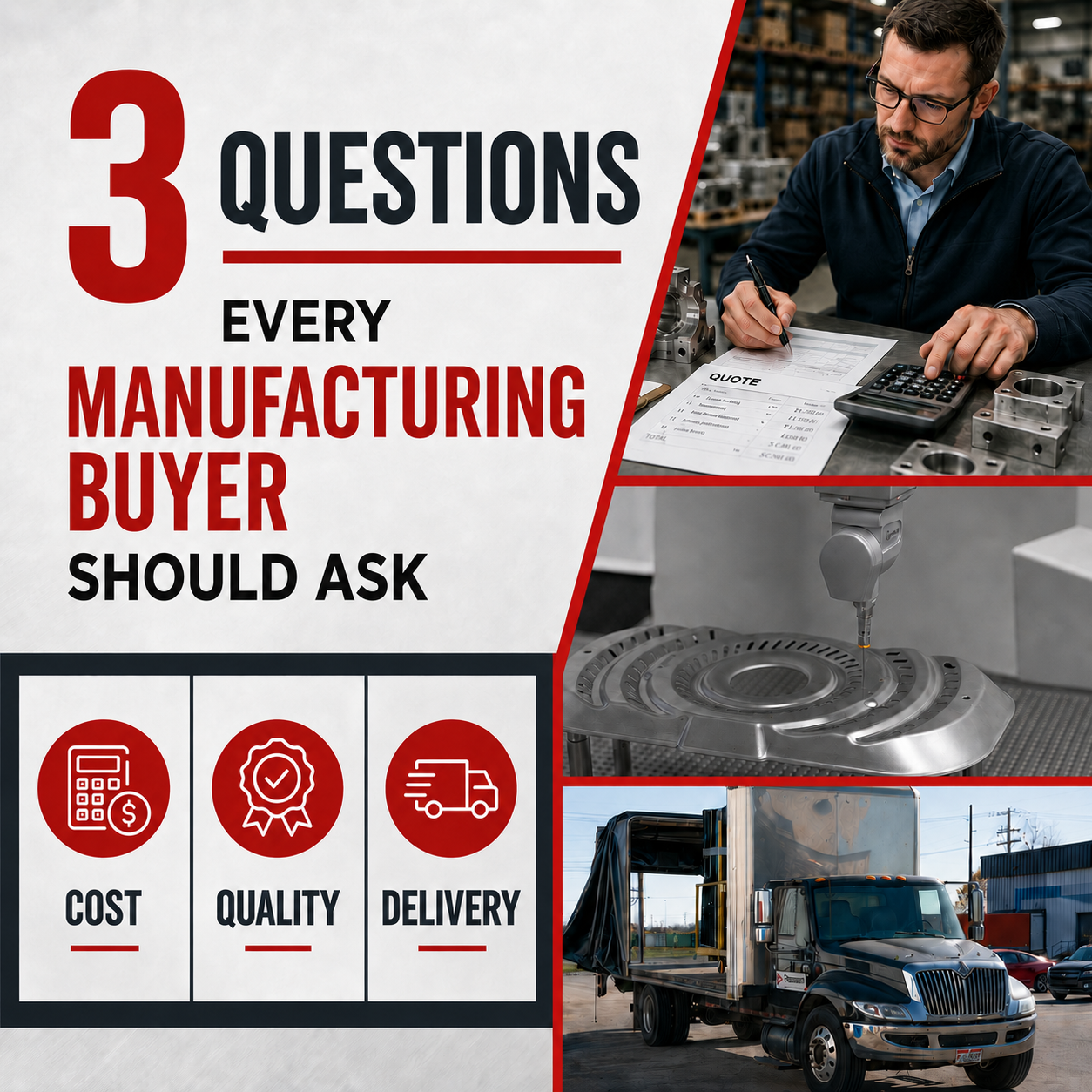
Cost, Quality, and Delivery: The three questions every manufacturing buyer should and do ask.
When our team visits customers, the same three questions come up in nearly every conversation. They’re the right questions to ask. Cost, quality, and delivery are the levers that decide whether a supplier relationship saves you money and headaches or creates them.
Here’s how we think about each one at Pennant, and how our processes are built to give you straight answers.
“What does this component cost?”
The honest answer to any serious cost question is it depends on the part. But a vague answer isn’t useful to you, so here’s what drives the number and how we work to keep it as low as it can responsibly go.
Component cost is shaped by material selection, part geometry, tolerances, secondary operations, and volume. Small design decisions upstream can have an outsized effect on price. A tolerance that’s tighter than the application requires, a feature that forces an extra operation, or a material spec that’s more expensive than the job needs will all show up in the quote.
That’s why we engage early with design for manufacturability. Before a part goes into production, our team reviews it against the way it will actually be made and flags the tolerance, feature, or material choice that’s quietly adding cost. Small adjustments at this stage often take real money out of the part without changing its function.
We also take cost out through supplier consolidation. Because we run stamping, roll forming, laser cutting, tube bending, fabrication, welding, and assembly across our operations, we can produce a part, or a whole assembly, that would otherwise require several vendors. Consolidating those operations with one supplier removes the markup, freight, and coordination cost of moving parts down a chain, and it makes the total landed cost easier to see and control.
And if you’re moving an existing part to us, our tool transfer expertise protects the investment you’ve already made. We bring in existing tooling, get it running in our facilities, and take over production without forcing you to start from scratch, which shortens the path to a better price on parts you’re already buying. When you ask what a component costs, what you’re really asking is whether it’s being made the smart way. That’s the conversation we want to have.
“What’s your quality process?”
Quality isn’t an inspection step at the end of the line. It’s built into how the part is designed, how the tooling is set up, and how the process is controlled from the first piece to the last.
Our approach starts before production with review of your drawings and requirements, so we catch issues when they’re cheap to fix rather than after they’ve been produced at volume. During production, we control the process itself rather than relying on sorting good parts from bad ones after the fact. Documentation and traceability mean that if a question ever comes up, we can tell you exactly what happened and when.
This is backed by people and equipment, not just procedure. Each of our plants has its own full quality control team, so quality is owned on the floor where parts are made rather than managed from a distance. For dimensional verification, we use CMM (coordinate measuring machine) inspection to confirm parts meet spec against your drawings with measured, repeatable accuracy, so the data behind a part is real, not a claim.
The practical result for you is fewer surprises: consistent parts, fewer line-down situations, and a supplier who can show the numbers behind the parts rather than just asserting they are good. If certification or specific quality documentation matters to your industry, that’s a conversation worth having up front, and we’re happy to walk through what we can support.
“How fast can we get our parts?”
Speed is really a question about predictability. What most buyers need isn’t just a fast lead time; it’s a delivery date they can plan around and trust.
Lead time depends on part complexity, tooling status, material availability, and volume. A new part with new tooling runs on a different clock than a repeat order. What we focus on is giving you a realistic commitment and then hitting it, because a date you can rely on is worth more than an optimistic one you can’t.
Running multiple processes across our facilities gives us flexibility to manage capacity and keep your parts moving without handoffs between outside vendors that add days and risk. For ongoing programs, we support just-in-time delivery: we plan production and inventory around your demand, so parts arrive when your line needs them, rather than starting the clock when the order lands. That keeps your carrying costs down and your production fed at the same time.
Geography works in your favor here too. Our four major plants sit in the heart of the Midwest, close to the country’s manufacturing base and to the freight lanes that serve it. That central footprint means shorter, more reliable transit to most domestic customers and more predictable delivery, whether you’re pulling parts weekly or scheduling a large program.
The thread that ties them together
Cost, quality, and delivery aren’t three separate problems. They’re the same problem viewed from three angles: is this part being made the right way, by a supplier who can prove it and deliver it on time?
The suppliers who answer these questions well tend to be the ones who engage early, control their processes, and keep operations under one roof rather than scattered across a chain of vendors. That’s the model we’ve built at Pennant.
If you’re weighing a new component or rethinking an existing supply relationship, those three questions are the right place to start. Bring us a part and we’ll give you real answers to all three.


